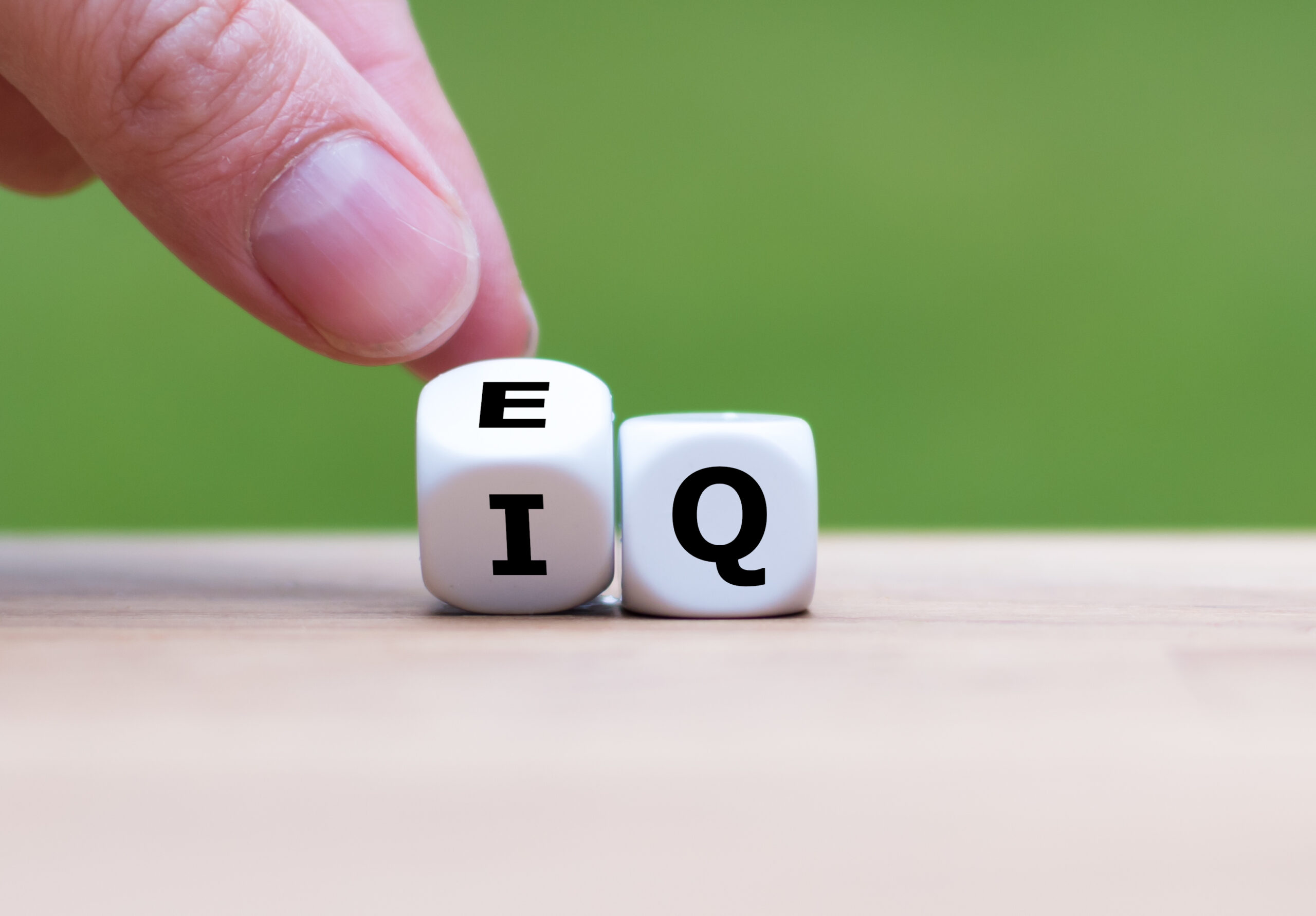
Emotional Intelligence: the Lawyer’s most underrated superpower
When we tell people that we help lawyers to cultivate emotional intelligence, it sometimes prompts a snicker. Surely Legal is one profession that remains unburdened by the need for empathy, but the evidence increasingly suggests that’s an outmoded stereotype.
There’s also occasional scepticism. Is emotional intelligence really learnable? Especially for a profession whose role is to bring a cold clear-eyed analysis to the table. The evidence increasingly suggests that it is. What’s more, lawyers who fail to recognise this are likely to perform below their potential.
Historically, the legal profession has been very much more IQ than EQ. But the two are not mutually exclusive. In fact, they tend to be mutually reinforcing. EQ is an essential element of performance and unlike IQ, it can readily be boosted.
Whether you are private practise or sit within a corporate structure, influencing without formal authority in increasingly complex matrix-style structures, is forever growing in importance.
Knowledge of the law is the basic table stake. Collaboration, influence, building trust and stakeholder management are the abilities that define top performers. Emotional intelligence provides the underpinning of all of these.
Take the example of Tom, a middle ranking inhouse lawyer at one of the world’s largest advisory firms. When we first met Tom, he was close to the end of his tether with Rhina, the senior partner.
Sharp-eyed as always, Tom had spotted a clause in the contract that the client wanted Rhina to sign. The clause risked triggering a weighty financial penalty. One missed testing milestone and the firm could be in hot water, even if it were no fault of their own. Tom had a reasonable solution that would nullify the risk, while likely still being acceptable to the client.
Rhina was resisting and this seemed illogical to Tom. He argued harder, pushing the facts, repeating the risks, marshalling the evidence, but Rhina appeared to be becoming more resistant not less. They were both stuck.
Once Tom stopped pushing and started listening, he uncovered the real issue: Rhina feared reopening old wounds after a disastrous earlier project that had nearly destroyed the client relationship.
The dynamic only changed when Tom was willing to do his homework. This meant putting himself in Rhina’s shoes and seeing the world from her perspective.
Like many people who are high in intellectual confidence, Tom didn’t find shifting from his default operating mode easy. But by being willing to work at it, he did manage to adopt a different style.
It didn’t mean that Rhina was right. But it did change the relationship enough for them to come up with a solution together – a simple project change notice rather than a confrontational contract renegotiation.
There are three evidence-based methods that we can use to cultivate our emotional intelligence: engaging with Fiction; mentalising; and emotional granularity.
Engaging with fiction is one of the most accessible and yet underrated methods of boosting emotional intelligence.
A study from the Department of Management and Organization at the University of Amsterdam shows that the capacity for empathy by engaging with fiction, is most powerful when something called ‘transportation’ takes place. Transportation describes the extent to which we are mentally and emotionally drawn into the story.
The greater the transportation the greater the impact on emotional intelligence.
This may help to explain the reason why, as a species, we have evolved a mental module for stories.
That’s why at Threshold as we enable lawyers to learn together, we invite them to step into a fictional world that mirrors their own, with characters – lawyers, clients, paralegals and other stakeholders – that they can relate to and situations that they can identify with.
Stepping back and looking at a situation in a parallel world allows lawyers to drop any defensiveness and genuinely explore different perspectives.
Emotional granularity
In her fascinating book, How Emotions are Made, Harvard psychologist and neuroscientist Lisa Fieldman Barrett, argues that the better and more finely-tuned our understanding of the various potential emotions people may have, the more we can understand them in ourselves and in others – and do something about them.
Thinking about and describing these potential emotional states – and being able to differentiate between them – boosts our emotional intelligence. This is what’s known as emotional granularity.
Using words to describe emotions, in as finely tuned and sophisticated a way as possible will enhance your EQ.
For example:
Are you disappointed? Or are you disheartened, discouraged, disillusioned or perhaps dejected?
Are you pleased? Or are you satisfied, gratified, charmed or thrilled?
You can also seek out and learn those words in various languages that describe specific emotional states or experiences that we don’t have a direct equivalent for in English.
Like the German word Schadenfreude, meaning a guilty sense of glee at someone else’s misfortune. Or the French word Dépaysement – that feeling of being in a foreign environment, disorientated.
Work on your emotional literacy. Find better, more accurate, more descriptive words, learn new words, and think about those emotional states that don’t have words to describe them but should… Better still invent your own words.
The third method that enhances emotional intelligence is mentalizing – actively making the effort to think about what others are likely thinking and feeling and seeing the world from their perspective.
The evidence shows that people who practice mentalising are more readily disposed towards teamwork, collaboration and cooperation.
We know this from the work of Gregory Berns, Director of the Centre for Neuro Policy at Emory University.
Collaboration takes trust. This is because we are always at risk from those who pursue their own interest in the short term, while the rest of us are focused on the shared interest in the longer term.
The philosopher Rousseau characterised this in terms of the Deer hunt and the Hare hunt: We can only catch deer if we collaborate and work as a team. This means everyone eats better. In the deer hunt, we must all take our positions and be able to rely on one another to stay in that position if the deer is going to be caught.
But suppose for example, I’m in my position in the deer hunt and a hare runs past me. I might be tempted to abandon my position and go after the hare. That would mean there’s a good chance that I get to at least eat hare. But this is at the cost of everyone else who will get to eat nothing.
If we trust everyone else on the team, it makes sense to hold out and eat deer. If the trust isn’t there, we’re tempted to look after ourselves and go for the hare.
So how do you build a team or an organisation of Deer hunters rather than Hare hunters? Well again, it seems that this is another case where EQ (emotional intelligence) is more important than IQ.
Berns and his team set up a series of Deer-Hunt-like games for people to play while their brains were scanned.
The aim of the game for the participant is to get the best pay off for themselves. If they choose to cooperate when the other person also chooses to cooperate, it’s the biggest win. But if the other person has chosen not to cooperate, you’ll be better off if you’ve chosen to cut your losses and not cooperate also.
Now, it does not necessarily follow that someone who is more likely to choose the option of collaborating is practising theory of mind or has any particular emotional intelligence. It may simply be a risk-benefit calculation based on a guess at what the others will do. This is what Berns hoped to test out.
Berns had two set-ups.
In set-up one, participants were playing against other people – in other words, they were guessing whether real people would choose to cooperate. In set up two, they were guessing on whether a computer programme would throw up a random cooperate or not-cooperate option.
If choosing to cooperate had little or no association with Mentalizing – thinking about what the other person was thinking and feeling – we would not expect to see much difference at all in brain activity between the two set ups.
But the results were eye-opening! When people chose the deer hunt approach – in other words they opted for teamwork and collaboration over looking after number one – and they were playing with actual people, there were significantly high levels of activity in the brain regions associated with mentalizing and theory of mind.
And there’s no such activity when people opt for non-cooperate or play against mere computer programmes.
It won’t surprise you to find that people with higher emotional intelligence are more likely to opt for the teamwork or collaboration options.
Emotional intelligence isn’t just about being nice to each other or creating a happier working environment – it’s essential for high performance. And with AI increasingly encroaching on all aspects of knowledge work including the law, your interpersonal qualities are your primary differentiator.


At Threshold, we are helping our clients to ensure that their human workforce is committed, engaged and ready for the technology revolution. We do this by bringing about small shifts in line manager behaviour that make a big difference. To find out more visit www.threshold.co.uk