How to protect yourself against the dark side of social proof
“None of us is smarter than all of us”. It was a popular business buzz-phrase in those optimistic days of the 1990s, when creative brainstorming was all the rage. It was intended to convey the power of pooling our collective intelligence.
Nonetheless, I always felt more convinced by the rephrasing of it by a hard-bitten older colleague: “None of us is dumber than all of us.” Call me cynical but somehow it rang truer.
It’s an indisputable characteristic of our species. We do dumb things because other people do them too. This applies to failing to save enough for retirement, eating or drinking too much, or driving too fast in dangerous conditions.
Interesting social experiment
Here’s an interesting social experiment that you can try out. When standing with other pedestrians, waiting to cross, at the curb side of a busy road, start to cross before the lights have changed, and note how many follow you. No don’t do that! Obviously! But you take the point.
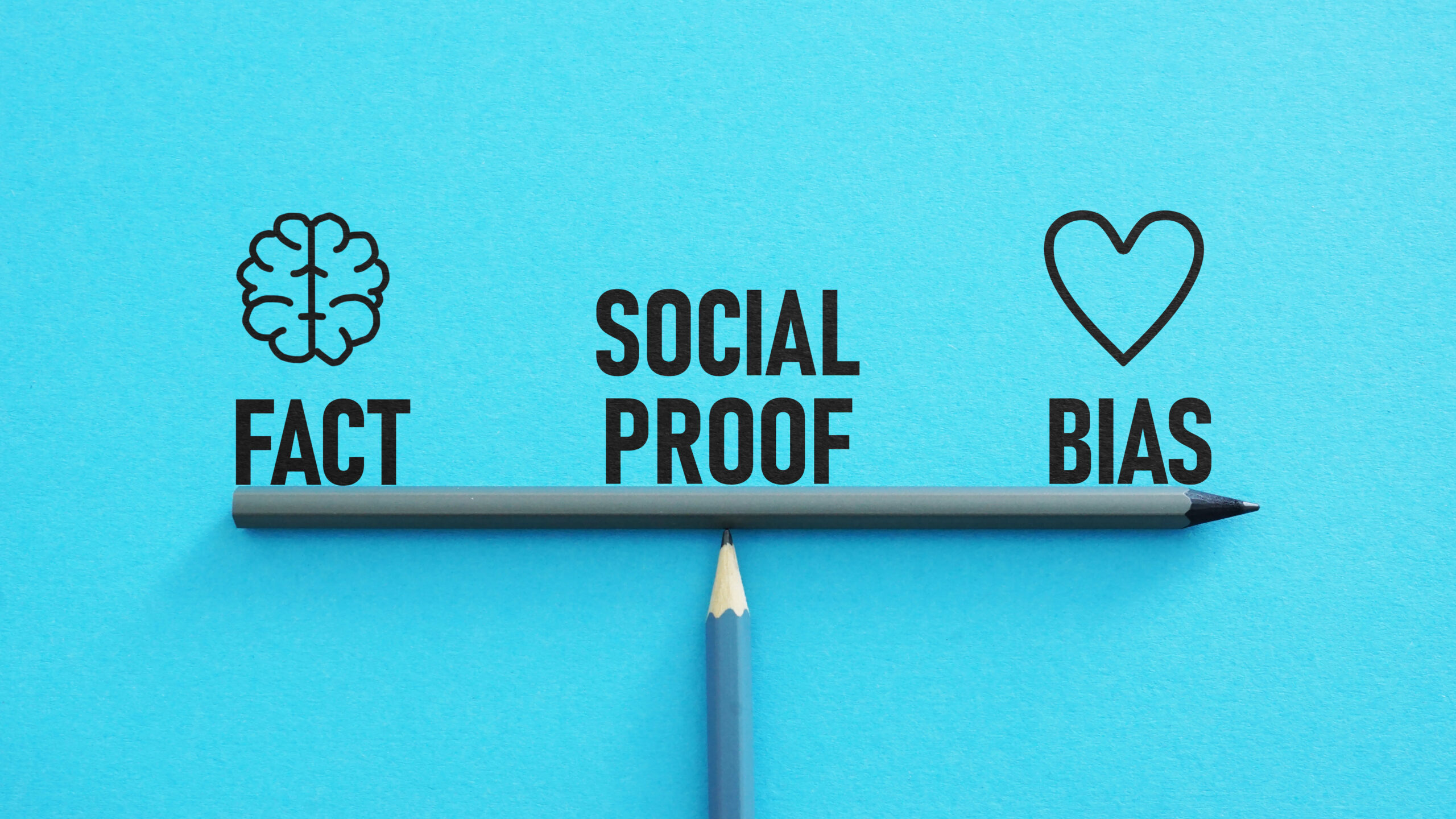
Advertisers have long exploited the psychological phenomenon of social proof. We do things that we would not otherwise do, because other people are doing them. Conversely, we fail to do things that we should do because others aren’t.
Social proof
Interestingly, wealth, status and social prestige do not protect us from this fallacy. If anything, they may make us more susceptible. Social proof is derived primarily by observing those that we consider to be our peers. Those who have the greater social prestige carry the greatest sway when it comes to social proof. And the more senior we are the more we move in a peer group of high-status individuals.
At this point, the alarm bells of business leaders should be ringing. Countless ill-fated business transformations, acquisitions or brand repositioning projects simply took on a life of their own because nobody else was questioning them.
Corporate leaders
Think of the cyclical trends we go through in business – diversification, consolidation, process re-engineering, acquisitions, centralisation, decentralisation – most are unrelated to what is going on independently in the external world. They happen because most corporate leaders are doing them at any given time – and most create little business value at best, or destroy it at worst.
The phenomenon is at the heart of every speculative bubble from the south Sea company and tulip mania in the 1630s, to the present day. Indeed, today’s fund managers are as susceptible as anyone. And you would need to have been living on Jupiter to have missed talk of potential bubbles in today’s business pages.
Put simply, when people we consider to be knowledgeable and experienced do dumb stuff we’re at great risk of following them.
Social proof
Think of Theranos, the elegantly simple technology for transforming at-home blood tests, championed by charismatic CEO, Elizabeth Holmes. It didn’t work and should have been seen through in a heartbeat by anyone with reasonably functioning bullsh*t antennae. But many of the smartest, most accomplished figures in business, politics and the military invested — not because they were foolish, but because they deferred to social proof. After all, if Rupert Murdoch has pitched in with $125M, who am I to question?
If you want to immunize yourself against the risk of social proof, it’s worth thinking of the Madoff ponzi scheme and the small channel island investment house who did not fall for it, when many of the rich and famous did. Madoff duped Steven Spielberg, Kevin Bacon, John Malkovich, Larry King and many other high-profile individuals.
Risk of social proof
At the height of the Bernie Madoff scandal, one of the most quietly revealing stories did not involve Wall Street titans or celebrity victims, but a small, cautious investment firm based in the Channel Islands. Unlike most of the financial world, they had never heard of Madoff. And that, paradoxically, turned out to be their greatest protection.
When Madoff’s representatives came calling with the opportunity to invest, the firm did not treat it as a once-in-a-lifetime invitation. There was no excitement about exclusivity, no deference to reputation, no fear of missing out. They simply applied their standard due-diligence process — the same questions they asked of anyone entrusted with clients’ money. How were trades executed? Who held custody of the assets? What independent verification existed? What transparency could be offered?
Relied on trust
Madoff’s team could not answer these questions in a way that met the firm’s minimum thresholds. Some responses were vague. Others relied on trust, status, or the implication that “everyone important is already in.” The representatives were astonished when the firm declined. After all, the ultra-wealthy individuals were scrambling for access, willing to suspend their usual scepticism for the privilege of association.
But the Channel Islands firm did not bend its rules — precisely because it had no reason to. With no prior reverence for Madoff’s name, there was no psychological pressure to reinterpret warning signs as acceptable risk. Their ignorance insulated them from social proof.
Power of social proof
In the aftermath, as Madoff’s fraud unravelled and reputations burned, this small firm emerged untouched. The lesson is quietly devastating: they did not survive because they were cleverer than everyone else, but because they had never heard of Madoff.
The story gives us an invaluable litmus paper against which to test any important decision before committing: Would I think this, if no one else I know thought it? Would I do this thing, if no one else I knew were doing it? Taking a beat to reflect on the power of social proof can, at the very least, protect you from being as dumb as the rest of us, and it may just leave you being smarter than all of us.
 To find out how we can help leaders in your organisation to be more impactful, influential and persuasive visit www.threshold.co.uk