The life of Jesse Jackson gives us a vital lesson about the way things change
(3 minute read)
Whether it’s in business life or wider society, the question of how cultures change is at the heart of either progress or regression.
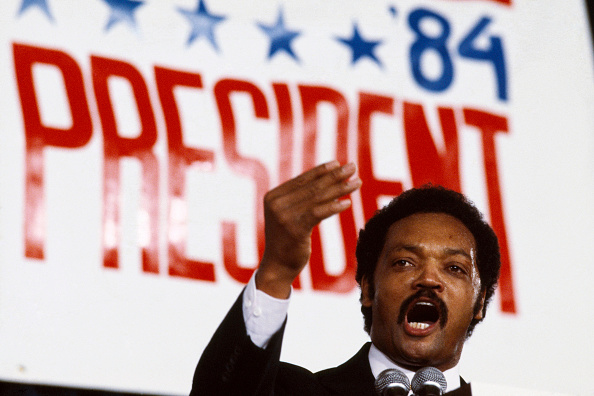
When Jesse Jackson ran for president in 1984, it’s hard to imagine just how eye-opening it was. Few believed he would win. But the idea of a black man, born into poverty in the deep south, being a substantive presidential candidate, loosened up the collective imagination. Seeing an African American in the Oval office seemed just a fraction less out of reach.
The nature of change
It’s always instructive to reflect on the nature of changes that we take for granted – one realises just how bizarre many of them would have seemed, if we were standing in the past looking forward.
Take the example of billionaire Sir James Goldsmith’s Referendum Party in the 1992 UK election. Goldsmith, seen as an eccentric outsider, championed the cranky idea of the UK exiting the EU and the world’s largest single market – an idea that was such an outlier, it caused then Tory cabinet minister David Mellor (who actually won the seat) to jeer, “You can pack up your bags, knowing your attempt to buy the British electorate has failed.”
Or, imagine entering the workplace in the early 1990s, when even the chicest offices were engulfed in a plume of cigarettes smoke. You would be issued with desk furniture that included an ashtray and cigarette lighter. Racist epithets would commonly be heard and go unchallenged. And a strippergram in the office would not be uncommon. The modern workplace is far from perfect, but collective norms of behaviour have made it kinder and more inclusive – not to mention healthier!
Social justice
Jackson, a man who dedicated his life to campaigning for social justice, in his 84 years, witnessed so many changes in the political and social landscape that are unquestionably for the better.
But not all is progress, I hear you say.
Social media and the hegemony of the algorithm have resulted in the normalisation of divisive, racist attitudes, the open expression of which would’ve seemed unthinkable a generation ago.
Normalisation of small steps
Put simply just as good things come about through the normalisation of small steps, bad things can do the same just as easily.
In his counterfactual novel, The Plot Against America, the writer Philip Roth, through the eyes of an ordinary New York Jewish family, imagines the US descending into rampant antisemitism, in a way that mirrors Germany in the 1930s. You guessed it – through a series of small steps, none of which seem too unreasonable on their own.
Overton Window
Perhaps the most helpful framework through which to understand this, is what’s known as the Overton Window. Joseph Overton, an American policy analyst who worked at the Mackinac Center for Public Policy in the 1990s, observed that think tanks and advocates rarely change policy directly; instead, they shift what policymakers believe is publicly acceptable. He described a “window” of ideas that politicians can safely support without risking their careers. As public attitudes move— one notch at a time —the window shifts with them. Policies once seen as radical then become mainstream.
Law of small steps
This is also known as the law of small steps. People are far less resistant to taking a small step than they are to taking a big one.
In a much-cited social psychology experiment, people in a given neighbourhood are asked by an undercover researcher whether they would be willing to put a rather large and obtrusive road safety sign on the side of their house.
Most people decline. The experiment is repeated in a similar neighbourhood, but this time the researchers start by asking whether they can put up a small, unobtrusive sign. They return every couple of weeks to ask whether they can replace the sign with a new one – each time somewhat larger. In the end, many participants end up displaying the larger more obtrusive sign, which was rejected by most, in the previous study.
Jackson didn’t make it to the White House. But the actions he took paved the way for change.
Nature of change
When we advise business leaders about the nature of change, whether that’s personal or organisational, we encourage a focus on small, definite and observable steps.
For better or worse change comes about through small steps being normalised. We can all start today. To find out how we can help leaders in your organisation to be more impactful, influential and persuasive visit www.threshold.co.uk